
The ChatGPT ad gap: why major brands are losing ground on brand comparison prompts

A full-month analysis of UK advertising data from July 2026 reveals two distinct brand-protection risks hiding behind conversational AI search: major consumer brands with zero platform presence, and active advertisers whose campaigns fail to trigger on direct, head-to-head comparison prompts.
In our previous article on PPC Live on ChatGPT Ads, we argued advertising on this channel is worth it to avoid losing customers on high intent brand prompts. This article dives deeper into how the data supports this stance.
Executive summary
To evaluate how ChatGPT ad auctions handle commercial intent, we indexed 34,638 UK ad responses across commercially relevant search prompts throughout July 2026.

The indexing data reveals a clear operational gap: when ChatGPT is queried with high-intent brand comparison prompts, the brands being evaluated are rarely the ones capturing the ad real estate.
● Indexing Scope: Our July 2026 UK index captured 34,638 total ad placements, including a dedicated subset across 4,215 unique comparison prompts ("Brand A vs Brand B")
● 0% visibility for some brands: Major household names like Levi's and Bosch had zero direct ad coverage on prompts explicitly comparing them against direct competitors
● Marketplace Interception: Multi-brand retailers (such as Zalando, Next, and Roman) and direct rivals consistently capture ad placements when named manufacturer campaigns do not trigger

1. Risk 1: complete platform absence
The most straightforward risk affects brands with no active advertising campaigns on ChatGPT. When a user queries ChatGPT to compare two or three named brands, the absence of an active ad campaign leaves the visual real estate open to rivals.
Case study: apparel & denim
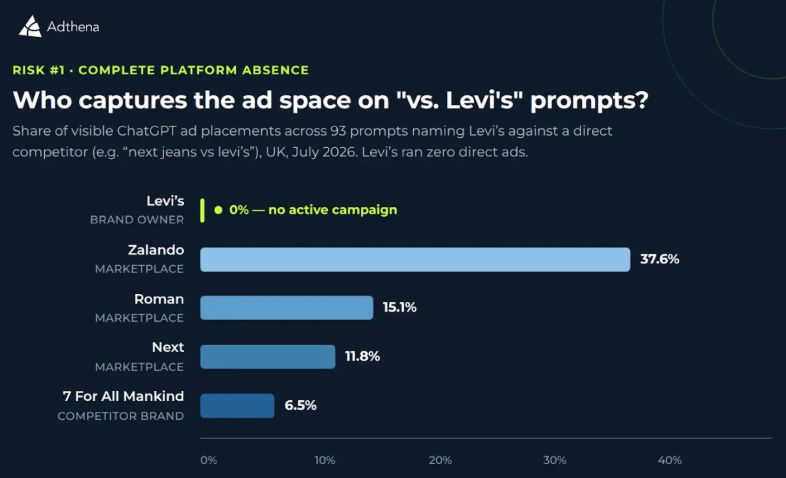
Across ad placements triggered by prompts naming Levi's (such as "next jeans vs levi's" and "diesel vs levi's women's jeans"), Levi's ran zero direct ads. Instead, multi-brand retailers and competing fashion brands captured 100% of the visible ad placements:
● Zalando: 37.6% share of visible ads
● Roman: 15.1% share of visible ads
● Next: 11.8% share of visible ads
● 7 For All Mankind: 6.5% share of visible ads
Case study: home & garden
Across prompts explicitly searching for Bosch equipment (such as "flymo vs bosch lawn mower" or "best pressure washer karcher vs bosch vs nilfisk"), Bosch had zero active ad placements running under its own brand entity. Third-party channels and direct competitors like Ryobi, Tesco & Lidl stepped into the prompt real estate.
When high-intent prompts evaluate your brand alongside a direct rival, your absence guarantees that competitor messaging or retail intermediaries define the commercial outcome.
2. Risk 2: platform spending without brand defense
The secondary risk is less obvious: brand managers spend on ChatGPT Ads, but their campaigns fail to trigger when queries explicitly name their brand.
Multi-brand marketplaces currently dominate overall ChatGPT ad share in the UK. The top advertisers across the entire index demonstrate how aggregated retail platforms aggressively buy up prompt share:
1. Zalando: 9.7% of total observed ads
2. Booking.com: 7.7% of total observed ads
3. Next: 3.9% of total observed ads
For direct-to-consumer (D2C) manufacturers and brand owners, relying on broad targeting yields generic category impressions while reseller partners or competitors capture the
immediate moment of purchase intent. Broad spending does not automatically guarantee coverage on your own named comparison prompts.
3. Operational playbook for marketing teams
To address both total platform absence and inconsistent brand coverage, UK marketing teams should implement four immediate steps:
1. Audit Key Brand Prompts: Map top-performing "Brand A vs Brand B" keywords from search engine marketing campaigns directly into ChatGPT context hints 2. Separate Upper-Funnel Reach from Brand Defense: Build dedicated campaign structures aimed explicitly at defending brand comparison queries rather than allocating all budget into generic campaigns
3. Track Intermediary vs Competitor Capture: Identify whether missing placements are going to authorized retail partners or direct category competitors. Profit margin impact differs substantially between the two
4. Establish Continuous Visibility Monitoring: With 2,882 advertisers active in July 2026 alone, auction dynamics shift rapidly. Keep a close eye on how ChatGPT’s advertising platform evolves, and how the competitive landscape is shifting.

Adthena’s weekly ChatGPT Ad index which summarizes advertising activity on ChatGPT. Research for this article uses the same data that powers the index, but we’re looking back at the whole month of July.
Protect your brand footprint
Unmonitored brand terms quickly become primary conquesting targets for competitors as AI auctions mature. You can check if your top competitors are already advertising on ChatGPT ads in Adthena’s free weekly index: https://www.adthena.com/chatgpt-ad-index/




Comments