
Brand & Generic Campaigns: Different Performance, Different Jobs

As PPC professionals, we’re familiar with having to achieve goals (e.g., generate X increase in revenue, by end of Q3) with finite resources (the budget is the budget). We make decisions about where to spend money to hit those goals, but it often comes with questions from stakeholders like “Why spend so much on Generics when it doesn’t provide an immediate return?”. We pit Generics against Brand, despite them serving totally different purposes and both adding unique value to a business.

In this article, I’ll break down my interpretation of the different functions Brand & Generics serve. This article and its insights are best applicable to large enterprise clients with strong market share & substantial budgets. Assertions about differences in metrics across Generics & Brand are based on my own observations.
Topline Differences in Brand & Generics
Brand, the golden child
We talk about the funnel in PPC and are aware that Brand searches often occur later in the buying journey, when a user has already developed a degree of familiarity or preference for a brand. As a result, we may benefit from higher CvRs & AOVs, as well as lower CPAs. In accounts I've worked on, Brand traffic has consistently delivered higher CvRs and AOVs alongside lower CPAs.
Better efficiency and stronger value from Brand keywords can create opportunities to promote higher-priced products (e.g., advertising your most expensive products via sitelinks attached to brand campaigns), with lower risk of people bouncing. It also means we can invest more heavily when we need relatively efficient conversions or faster revenue generation, as the time from click to conversion is often shorter.

Generics, the seed that sprouts into a tree
Generics, in comparison, often appear less efficient, bringing in lower basket value customers at a higher acquisition cost. If we assess Generics purely on its return, it’s tempting to cut it and put the money back into Brand. However, doing so risks ignoring the unique benefits Generic keywords provide.
This is because Brand search volume is finite at any point in time. At some point, we hit diminishing returns where we keep investing, but we’re already capturing most of the available impressions & seeing CPAs rise as a result. Additionally, spending more to harvest additional demand (when demand is finite) will not drive meaningful scale, particularly if your client is a big business with strong market share. This is where Generics steps in. It’s unlikely you’re capturing the bulk of Generic available impressions & thus have greater room to scale spend via these keywords.
So, rather than acting as an efficiency and value engine, Generic keywords offer the following value.
Generic keywords have a greater ability to scale, reaching more people who aren’t yet decided on a brand or a solution. This is because, generally, Generic search categories will often have considerably greater total search volume available than Brand terms. The screenshot below shows an example of this. Searches for “Best computer” (Generic) are higher than those for “Currys computer” (Brand). This pattern holds with other Generic vs Brand searches I’ve pulled data for.

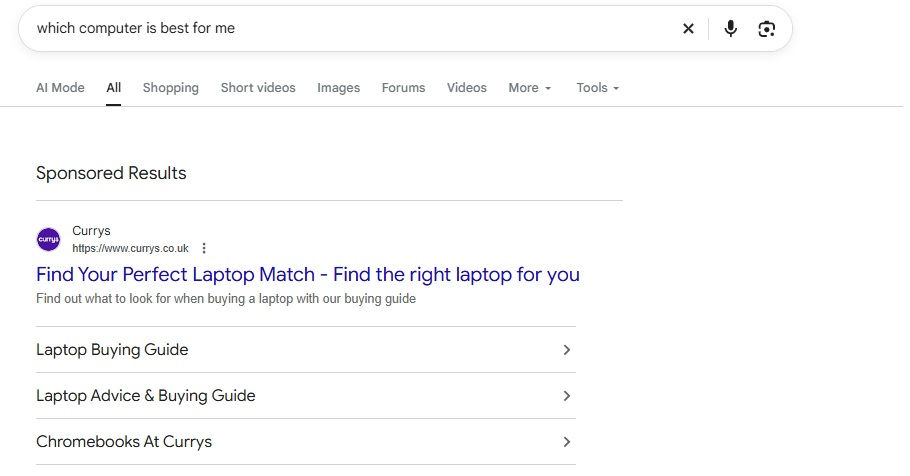
Using this greater scale, you can nudge more people towards your brand, especially since we don’t run advertising in isolation and are trying to win the same customers our competitors are. Generic advertising allows us to show up when someone is performing a broad search & answer their questions (e.g., “Which type of computer is best for me”) with ad copy + a sitelink that will direct the searcher to a computer finder quiz, like in the screenshot below.
Or you can display ads directly calling your (relative) benefits out to the customer. If, after doing audience & competitor research, you discover that your target audience really wants laptops that fit snugly in their bags, but your competitors’ ads only talk about battery life, that’s your opportunity to slot your ads in and directly address their needs.
Reddit threads (audience insights) + Transparency Centre (competitor ad scoping) are a good way of finding and bridging these gaps, so that people conducting generic searches engage with your brand, land on your site, and potentially begin their transition from generic to brand.
In some accounts I reviewed, Generic appeared at the beginning of >8% of conversion paths (on average), with subsequent searches being for Brand terms. While this doesn’t prove causality, it does suggest Generic plays an important role in discovery and consideration (prior to narrowing down to a Brand search).
What Does This Mean?
Put simply, when you’re managing a budget, it’s important to not get bogged down in the metrics. Looking at CPAs (etc.) helps to make decisions, but if you see that Generics’ CPA is significantly higher and decide to cut it based simply on that, you’re missing out on future demand generation or the ability to win those customers your competitors are eagerly acquiring.
A better approach is to review your budget & write a pros and cons list that expands beyond immediate platform metrics. I’ll give an example. Let’s say the CFO is asking why we’re still investing in Generics, despite it having a higher CPA. If we relied on platform metrics, we’d just pull back spend. But, if we mapped some of the benefits seen outside of short-term performance, we might be able to build a stronger case for keeping Generics alive.

A few examples of probing questions you could ask to determine whether Generic investment is beneficial are:
Is Generics more effective at new customer acquisition?
Does Generics help increase market share by being present when customers are considering multiple brands (& intercepting their decision)?
Does Generics generate stronger incremental performance (e.g., generating sales that wouldn’t have occurred without advertising)?
Of course, you’ll still have to find a way to quantify the impact of these, but it’s a more complete picture than relying solely on short-term data. The point isn’t to force Generic spend, more so to add more context that you can use to evaluate whether Generic provides enough value to continue investing before slashing it.
So, Who Wins? Brand or Generic?
The lesson here isn’t that Generic deserves unlimited investment or that you must now go and hound the CFO for more budget to invest in Generic. It’s that each type of advertising offers unique benefits, and you should consider what the client needs in the short (e.g., people to buy a premium product you’ve just released) & long-term (a pipeline of customers/leads to ensure future demand is as consistent as current). Then, you can consider how you’ll balance your budget to meet those.




Comments