
PPC lead generation form: the ultimate guide

I keep hearing that lead forms should be as simple as possible. While this stems from good intentions, it's unfortunately often a simplistic approach. It boils down to saying: "I'll generate as many leads as possible. As for quality, that's the salesperson's problem ."
It's in moments like these that I'm amazed by the lack of strategic thinking in some teams! And then we wonder why salespeople don't like marketers… 🤦
My advice? Integrate your lead form at a strategic level . How? That's what this article is about:
The purpose of a lead form
I may be stating the obvious, but don't they say: "it goes without saying, but it's better to say it"?
Asking a prospect to fill out a lead form indicates that the sale is relatively long and complex. Otherwise, we'd be e-commerce businesses selling our shoes directly online.
It is this complexity that necessitates a lead form: its primary objective is to eliminate unqualified prospects . Why? Because the sales team does not have infinite resources (just like the marketing team, right? 😉).
Therefore, it's immediately clear that the best practice of reducing the number of fields in a lead form isn't a universal rule. Furthermore, I strongly suggest you be wary of "professionals" who follow universal rules: the world isn't made of 0s and 1s.
So what to do? I advise you to adapt your lead form objective according to your offer and your audience.
The lead form depends on your offer
Depending on your offer, your sales time and the customer journey, your lead form will be more or less elaborate.
Imagine your product or service is relatively simple . For example, a business school that recruits students without charging tuition fees (let's say the program is a work-study program, fully funded by the company). The customer journey: provide the course catalog… and wait for applications.
In this scenario, recruitment is relatively straightforward: your form needs to be adaptable and broad . Therefore, there's no need to ask for a lot of details. The usual name, surname, email, and phone number will be more than enough… and the rest will be handled through a simple lead nurturing process: “upload your application to our platform and we'll get back to you.”
Now, let's consider the opposite scenario: your product requires a huge amount of approval . This is exactly what you'd find with banks. Try opening a business account… it won't be nearly as quick as applying to business school!
In this scenario, the customer journey will likely involve several steps . You'll need to provide documents like a company registration certificate (Kbis) and other proof that you're not a scam. Relatively few people have had the opportunity to do this in their lives… so I encourage you to try it out to see how lengthy the process is. It will make you put the "cumbersome" nature of your own lead form into perspective 😀
In short, the key point here is that you should do the exact opposite of "best practice" : your lead form shouldn't cast a wide net. On the contrary, it should close as many doors as possible. Why? Because your offer can't do without this information anyway. So your customers will adapt. If they don't, they simply weren't good prospects, that's all. 🤷
The head form also depends on your audience
Here, I will be talking specifically about Persona. I therefore refer you first to our guide on the Buyer Persona .
Having done this, you should be able to identify the motivations and frustrations of your target audience . Therefore, why not incorporate them into your lead form? Typically, this will allow you to distinguish qualified prospects from others early on.
Let's take an example: you sell custom-made mosquito nets. Seasonality will inevitably play a role: here's a view from Google Trends for this keyword in France. We can clearly see the impact of seasonality on this market.
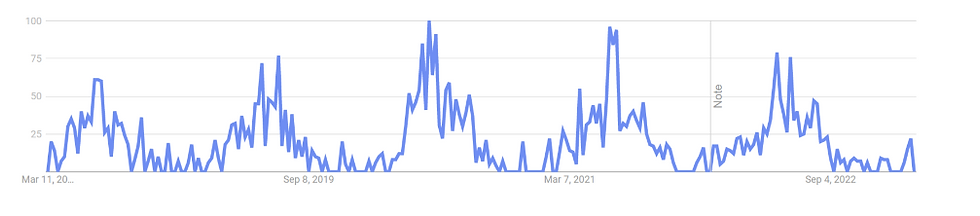
It will therefore be beneficial to be able to adapt your resources according to this timeline. Receiving quote requests through your lead form is good. But if you can also understand the project completion date, that's even better!
So even though this additional field will inevitably impact your lead form completion rate, it will have considerable value for the company … which will be worth a few extra cents per lead.
Again: don't just think about your cost per lead, but about the positive impact you can have on the entire value chain. Saving time for the sales team is worth its weight in gold! 🪙
The lead form: on a landing page?
In the same spirit as above, you will need to adapt your marketing around the lead form according to your offer.
Typically, if you have a simple offer, why not use a lead form directly integrated into Facebook Ads (for example)? This way, you can maximize your lead form completion rate because the customer journey will be faster and smoother.
It will be cheaper (no landing page), easier to adapt if changes occur… and also more interesting in terms of data. But I'll come back to that later in this article.
Conversely, if your offer is complex, you will likely need to explain it in detail. This will incur additional costs, if only to build the marketing pitch around the form … typically a landing page.
Note that while this feature might seem daunting to those unfamiliar with it, it's actually very useful for more complex offers. Having "gated content" (which essentially requires providing contact information) allows you to link all interactions with a single prospect... and therefore know when it's time to send them a salesperson!
You'll also notice that the goal of the ideal lead form isn't to be filled out by an army of brainless prospects... but rather to get them to do the work 😈
However, don't put words in my mouth: asking someone to prove their credentials can very well go hand in hand with a user experience and a smooth user journey .
Logically, the next step to help you design your lead form is to assess your prospect's position in the customer journey:
Lead scoring: the lead form within the customer journey
Imagine you've just discovered a complex product. It seems to align with your needs, but you can't make a decision yet. It's simply too early. You're a "cold" lead .
Naturally, at this stage, the lead form can't ask for too much information. We're gently guiding the prospect into a sales funnel. So, name, surname, email, and phone number are already quite a lot.
As interactions progress, you'll feel more comfortable engaging... I suddenly feel like I'm talking about a romantic relationship! 🤣 Seriously, contacting a salesperson to get a demo (for example) will now be considered normal. You've become a "hot" lead !
The logical next step is therefore to provide more qualifying elements such as the precise budget, the HR resources associated with the project, the SIRET number, etc.
In the jargon, this is called “lead scoring”: at each valuable interaction, the prospect will be labeled as more or less hot.
Here is an example of a customer journey and its scoring :
First visit to the site (+5 points)
Downloading a white paper (+5 points)
Video viewing lasting more than two minutes (+5 points)
Completing a contact form (+30 points)
Demo completed (+50 points)
Machine leadning: Marketing vs. Sales Constraints
Depending on your organization, you'll end up with more or fewer leads. Modern marketing is heavily reliant on data . If lead volumes are too low, no machine learning tool will be able to perform effectively.
A quick aside on this topic: in Machine Learning, there's the "Learning" part . So without data to feed the tool (the Learning component), there will never be any learning. This will result in mediocre performance. Worse, this meager data will feed an algorithm that will search for similar leads… which are therefore mediocre. And so on… 🤦
Beware of the vicious cycle: while a salesperson's time represents money, that's no reason to shoot yourself in the foot before you've even started!
How do you proceed in this case? Easy: you need to track every interaction in the customer journey . And adapt your marketing objective based on the volume of data (and therefore leads) present at each milestone.
Let's say, for example, that your customer journey is too simple: a lead contacts a salesperson and then makes a purchase. If your lead volume is too low, it's probably because your customer journey is too short. You need to implement a lead scoring system, as explained above. This will allow you to break everything down into multiple " micro KPIs " that all contribute to your macro goal .
AB test: example of the SIRET field
Here is a real-life example from one of the agency's clients. The sales team had initially requested a "SIRET" field in the lead form.
As our discussions progressed, we realized that the prospects we were targeting weren't enthusiastic enough. The logical consequence was that they wanted to know more before revealing their true intentions. This manifested itself in their behavior through inaccurate information: the SIRET number field was incorrectly filled out.
Result: not only was our completion rate weakened , but the sales team gained no benefit!
So, we collectively decided to remove the "SIRET" field and see the impact on performance. The results were undeniable: year over year, we increased the lead form completion rate by 63% . Amazing! 😯
It's worth noting that this also resulted in a slightly lower lead quality level. But it was worth the cost (a 63% increase!). As a result, we postponed the SIRET registration question until later in the customer journey.
The logical next step in this test: the order of the questions. That's convenient, because that's my next point:
A/B test: example of question order
This is another client of the agency and another real test: a relatively long onboarding form … and therefore with multiple “drop-off” points.
The hypothesis was that a prospect at the beginning of the process was not comfortable with sharing their personal information .
So the more we postpone these steps, the better it would be: the prospect would be more confident that we can offer him what he needs (through the relevance of the steps and questions in the form).
Without going into details (for confidentiality reasons), by changing the order of the questions to only ask for generic information first, we increased the lead form completion rate by 21% .
Here, it was a pure and simple gain: no loss in quality. What more could you ask for? 😃
Lead generation form: 8 best practices
I've focused heavily on best practices for lead generation forms in this article… but that's solely to get you thinking. And to help you align your work with your objectives and strategy.
Here are 8 generic best practices that you should be able to apply safely (or almost safely):
Position your lead form “above the fold”
Explain why we should fill out the form (what is the value for the user?)
Ask one question per form step, no more (example: Typeform)
Locate your prospect within the form (“question 8 out of 10, you’re almost there!”)
Differentiate the lead form completion CTA
Exclude internal IPs, especially for testing.
Design your form for smartphones, not just computers
Include your privacy policy
Conclusion: the leas form is not automatic
As you've probably gathered, the lead form isn't a basic element you can just brush aside. It's an integral part of your acquisition and conversion strategy . Remember to tailor it to the customer journey and analyze its data—it's a goldmine! 🪙






Comments