
Why Treating Every Product the Same in Google Ads Is Quietly Destroying Ecommerce Profit

One Performance Max campaign. One target ROAS. One budget. One definition of success.
I see this setup almost every time I audit an ecommerce Google Ads account. And five years ago, it might even have been fine.
But look at what's happened since. Tariffs have pushed up landed costs. Supplier prices keep rising. Employer National Insurance went up (if you’re based here in the UK). Consumers are spending more cautiously than they have in years. Returns haven't magically disappeared, and fulfilment certainly hasn't got any cheaper.
Almost every ecommerce business I speak to has had to rethink how it operates - renegotiated with suppliers. Trimmed the range. Looked hard at pricing. Some have restructured entirely.
Yet inside their Google Ads accounts? Nothing. Same campaigns, same targets, same structure - as though nothing in the business has changed.
That gap is becoming one of the most expensive mistakes an ecommerce brand can make. And the really dangerous part is that the damage doesn't show up anywhere in your dashboards. The metric everyone stares at is the exact metric hiding it.
Let me explain what I mean.
Google doesn't know your business
Let's get one thing straight before anyone accuses me of Google-bashing.
Google Ads is incredibly good at what it does. Give it enough data, and it will find people likely to buy with a precision no human media buyer can match. That part isn't in question.
But here's what Google Ads is not good at: understanding your business.
Google doesn't know you've just absorbed a 15% supplier cost increase. It doesn't know one product's margin halved because of tariffs while another quietly became your most profitable line. It doesn't know which products create repeat customers who come back for years - and which ones get bought once, returned half the time, and never reordered.
It doesn't know any of this because you haven't told it.
Google only knows the signals you give it. If your account structure says every product is equally valuable, Smart Bidding will treat every product as equally valuable - and spend your budget accordingly.
Sounds obvious, right?
And yet thousands of accounts are set up in exact contradiction of it. The business knows perfectly well that a clearance rug and a full-price sofa are commercially worlds apart. The Google Ads account says they're identical twins.
That's not an algorithm failure. That's the algorithm doing exactly what you asked. If you're frustrated with where PMax is spending your money, the first place to look isn't Google's black box. It's your own instructions.
ROAS doesn't pay your wages
This is where I think ecommerce has accidentally trained itself to optimise the wrong number entirely.
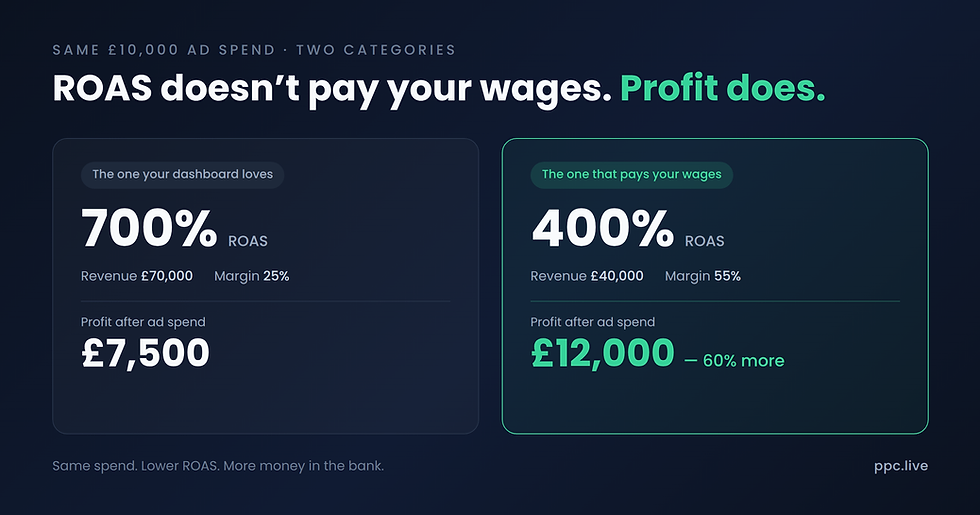
We've all sat in that meeting. Someone puts a 700% ROAS on the screen and the room nods approvingly. Nobody asks the follow-up question.
So let me ask it. Seven hundred per cent of what, exactly?
Here's a worked example. Two categories, each spending £10,000 a month:
Category A | Category B | |
Ad spend | £10,000 | £10,000 |
ROAS | 700% | 400% |
Revenue | £70,000 | £40,000 |
Gross margin | 25% | 55% |
Gross profit | £17,500 | £22,000 |
Profit after ad spend | £7,500 | £12,000 |
Category A looks like the star performer in every Google Ads report you'll ever pull. Category B makes 60% more actual money. And that's before we layer in Category A's higher return rate, which in the real world usually makes the gap even wider.
Now - and this is the bit that should genuinely worry you - ask what a single account-level tROAS does with these two categories.
It pushes budget towards A. The "efficient" one. And it quietly starves B, the one actually paying your wages.
Every month. Automatically. At scale. With no human ever making that decision on purpose.
I've seen accounts where this has been running for years. Years of budget flowing to the products that look best and away from the products that earn most. When you finally do the maths, the number is usually uncomfortable.
Google isn't wrong here. It's following instructions. The problem is that most businesses have asked it to maximise conversion value when what they actually need is commercial value. Those sound similar. They are not the same thing. And the gap between them is precisely where ecommerce profit leaks out.
ROAS is a ratio. Profit is money. You can't bank a ratio.
Not every product deserves the same strategy
Let's make this concrete. Imagine you sell furniture.
Your catalogue includes a £25 accessory, a £2,000 dining table, a clearance range you need shifted before the new season lands, a premium collection, a hero bestseller that basically sells itself, and a made-to-order line with a six-week lead time.
Would you price them all the same?
Of course not. Silly question.
Would you expect identical margins from all of them? Hold the same stock depth? Give the buying team one blended target across the lot?
Again - obviously not. You'd laugh anyone out of the room who suggested it.
So here's the question that should sting a little: why are you advertising them with one campaign, one ROAS target, one budget and one optimisation process?
Because that's precisely what's happening inside thousands of Google Ads accounts every single day. And I understand why. It's convenient. It's easy to manage. It's what the interface nudges you towards. One campaign, tick the boxes, let the machine get on with it.
It's also commercially lazy.
I don't say that to be harsh. I say it because hard trading conditions are exactly what expose lazy structures. When margins were healthy, a few bad allocation decisions disappeared into the blend and nobody noticed. A wasted £500 here, a low-margin sale there - the overall number still looked fine.
Today those decisions are magnified. Every unnecessary click matters. Every wasted pound matters. Every low-margin sale that displaced a high-margin one matters. The blend doesn't hide anything any more, because the blend itself is thinner.
Here's what I've noticed about the brands still growing through this period. They're not necessarily spending less on Google Ads. Some are spending more. What's changed is the question they're asking.
They've stopped asking "how do we improve Google Ads?"
They've started asking "which products deserve our advertising budget?"
Read those again. They're completely different questions. The first one sends you fiddling with bids and creative. The second one sends you into your P&L. Guess which one moves the needle.
How to actually fix it
Right. Enough diagnosis. Here's the treatment - and fair warning, this is feed and structure work, not bid-tweaking. The sequence matters, so don't skip steps.
1. Get profit visibility at SKU level. You can't segment what you can't see. Pull gross margin per SKU - after product cost, shipping, payment fees, packaging and expected returns. A spreadsheet is absolutely fine to start with. And if you can't produce this? Then congratulations, you've just found your real problem, and no campaign structure on earth fixes it. Sort this first.
2. Label the feed. Custom labels exist for exactly this purpose, and most accounts leave them empty or fill them with something useless like brand name (which is already in the feed - why are you duplicating it?). Tag every product by margin band - say, under 30%, 30–50%, over 50% - plus price point, stock position, lifecycle stage and strategic role. Hero, traffic driver, repeat-purchase generator, clearance. The feed is the interface between your commercial strategy and Google's automation. Treat it like one.
3. Split campaigns along commercial lines. Not by category because Google's interface makes categories easy - by economics. High-margin evergreen lines get their own campaign with headroom to scale. Thin-margin traffic drivers get a tight tROAS that reflects their actual breakeven. Clearance gets a deliberately aggressive target, because the alternative is dead stock and tied-up cash, and cash sitting in a warehouse is a cost too. Made-to-order gets treated differently from in-stock. Your structure should read like your commercial strategy. If someone from finance looked at your campaign list, would they recognise the business? If not, that's your answer.
4. Set targets from the maths, not from habit. Breakeven ROAS is 1 divided by gross margin. That's it. That's the whole formula. A 25% margin product breaks even at 400% - so a 500% tROAS on that line is barely worth having. A 55% margin product breaks even at 182% - so demanding 500% from it means strangling your most scalable profit engine for no reason. And here's the kicker: most accounts I audit have this exactly backwards. The tightest targets sit on the products that could afford the loosest ones. Sounds mad when you say it out loud, doesn't it? Yet it's everywhere, because targets get set once, by feel, and never revisited.
5. Feed profit into the machine where you can. Value rules, profit-adjusted conversion values, margin-weighted revenue - pick your method, but get Smart Bidding chasing pounds of profit instead of pounds of revenue. Once you do, all that machine-learning firepower starts working for your P&L instead of quietly against it.
Do this properly and performance improves. Not because Smart Bidding suddenly became smarter - it's the same algorithm it was last month. Because your strategy did. You've finally given the machine something worth optimising towards.
Google Ads isn't your strategy
One more misconception worth killing while we're here: the belief that Google Ads is the strategy.
It isn't. It never was. Google Ads is the execution layer.
Commercial strategy comes first. The business decides which products matter, which margins matter, which customers matter, which objectives matter. Google Ads then amplifies those decisions - loudly and expensively, in whichever direction you point it.
Too many businesses run this the other way round. They let campaign performance dictate commercial priorities. The products PMax "likes" get the stock, the features, the attention.
That's like letting your sat nav decide where you're going on holiday.
It will find you the quickest route. Brilliantly, in fact. It has absolutely no idea whether you're heading to the right destination.
The next few years won't reward better marketers
They'll reward better commercial operators.
The brands that keep winning through this period won't necessarily have better creative. Or cleverer bidding scripts. Or bigger budgets. They'll simply understand their numbers better than everyone else - which SKUs deserve investment, which customers create long-term value, which campaigns generate actual profit rather than reported revenue.
Google Ads is becoming less about buying traffic and more about allocating capital. That's a different discipline. It needs different questions, different structures and, frankly, a different mindset. Most accounts aren't built for it yet - which, if you move first, is an opportunity.
The ecommerce landscape isn't getting easier. Margins will keep moving. Costs will keep rising. Consumer behaviour will keep evolving. Your Google Ads strategy needs to evolve with it.
Because the biggest risk facing ecommerce brands right now isn't Google's automation.
It's continuing to treat every product as though it's commercially identical.
They aren't.
And your account shouldn't pretend they are.






Comments