
After Google’s August 17 Smart Bidding Update: What PPC Practitioners Are Actually Doing

Updated: Sep 22
Google’s August 17 Smart Bidding change generated plenty of debate before it arrived. Now comes the more useful question: what should advertisers actually do about it?
The update changes how Smart Bidding behaves for budget-constrained campaigns using Target CPA (tCPA) or Target ROAS (tROAS), including Maximize Conversions and Maximize Conversion Value campaigns with targets attached.
Historically, a budget-limited campaign could substantially outperform its stated efficiency target. A campaign with a 400% tROAS, for example, might consistently deliver 550% or 600% ROAS while spending its available budget.
Under the new behaviour, Google says Smart Bidding will more consistently optimise towards the target advertisers have actually set, regardless of whether the campaign is budget constrained.
Google has framed this as a predictability and consistency improvement. Critics have argued that it removes a useful optimisation technique and could encourage advertisers to spend more.
Following our earlier coverage of the backlash to the update, Founder and President of Digital4Startups Inc. Reva Minkoff and Founder of Grayvault Consulting Inc. Craig Graham joined the PPC Live community to answer advertisers’ questions about the change — and, more importantly, what they should now be doing and looking out for in their accounts.
The conversation moved beyond whether Google’s change was “good” or “bad” and into the practical decisions PPC practitioners are now facing: Should you raise a tROAS when actual ROAS is consistently higher? Which metrics can reveal the impact of the update? How should budget and tCPA relate? When should advertisers prioritise volume over efficiency? And when performance suddenly drops, how do you determine whether Smart Bidding is actually to blame?
Their answers revealed an important theme: the August 17 update makes it more important than ever to understand what your targets are telling Google — and whether those targets reflect what the business actually wants.
I’d use this in place of the existing introduction and then go directly into “If you’re beating your ROAS target, should you raise it?”
If you’re beating your ROAS target, should you raise it?

This is probably the most immediate question for advertisers.
Imagine a budget-limited campaign with a 400% Target ROAS that has consistently been producing 550%.
Should you move the target closer to 550%?
For Reva Minkoff, the answer is yes.
“I would definitely recommend moving your Target ROAS up towards the actual.”
Her reasoning is straightforward. If Google is going to treat your target more literally, advertisers need to be more deliberate about what they tell the algorithm they actually want.
“With the new bidding rules, it's extra important to be proactive because Google will no longer prioritize outperforming your target, so you have to make sure you're telling them where you want to be,” she explained.
That broadly mirrors Google’s own guidance. Google Ads Liaison Ginny Marvin said that advertisers who want to preserve the efficiency they are currently achieving can move their target towards their current average performance.
But Craig Graham added an important warning: before changing anything, make sure the August 17 update is actually responsible for what you're seeing.
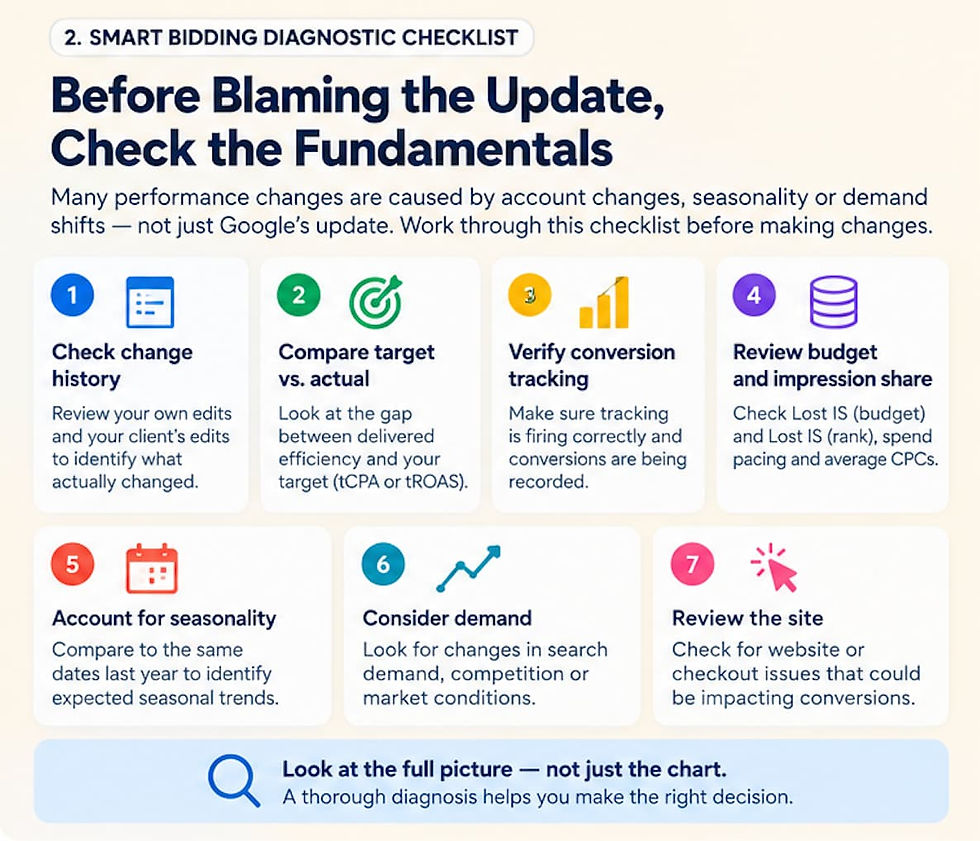
Before blaming Google, check your change history
Graham went looking for evidence of the update in two ecommerce accounts.
He compared pre- and post-update windows, reviewed change histories, used a control group and compared performance against the same period in the previous year to account for seasonality.
The result?
Nothing particularly interesting happened.
“What the data shows is that nothing detectable moved in these accounts. Efficiency versus target shifted less across August 17 than across an ordinary mid-month boundary in the same accounts.”
There was a good reason.
Targets had already been reset to realistic levels in the two weeks before August 17. Delivered efficiency had therefore moved closer to the targets before Google’s change arrived.
There was effectively no remaining gap for the new bidding behaviour to close.
“The accounts that prepared had a boring update,” Graham said, “and boring was the goal.”
There is a broader lesson here for anyone analysing the impact of a Google Ads update: don't start with the chart. Start with the change history.
If an advertiser increased a tROAS shortly before August 17 and ROAS subsequently moved closer to that target, the resulting graph could look remarkably similar to the effect expected from Google’s update.
Without checking the change log, correlation can quickly become a convincing but incorrect diagnosis.
Seasonality creates the same problem.
In one account Graham examined, efficiency historically softens by around 9% in late August. Without a year-over-year comparison, that recurring seasonal movement could easily have been attributed to the Smart Bidding change.
And ten days, he cautioned, was still a short post-update observation window.
Does the change only matter if you're Limited by Budget?
Technically, yes.
Google says campaigns that aren't budget constrained should continue behaving as they did previously. The behavioural change occurs when a target-based campaign becomes constrained by budget.
Graham therefore described the directly affected group as campaigns that are limited by budget and use tCPA or tROAS, including Maximize Conversions or Maximize Conversion Value campaigns with a target attached.
Minkoff, however, argued advertisers should think more broadly.
A campaign that isn't budget limited today might become budget limited tomorrow.
Demand changes. Spend fluctuates. Seasonality arrives. Competition changes. Budgets get reduced.
Her recommendation is therefore to treat the update as relevant to any campaign using tCPA or tROAS, because budget limitation is a campaign state rather than necessarily a permanent characteristic.
That distinction matters.
Rather than waiting for “Limited by Budget” to appear before asking whether your target represents the economics of the business, the safer approach is to decide what your target actually means now.
The most important new diagnostic: target versus actual
Much of the Smart Bidding conversation traditionally revolves around familiar metrics: CPA, ROAS, CPC, conversion volume, impression share and budget.
Those still matter.
But after this update, one relationship deserves particular attention:
Target efficiency versus delivered efficiency.
If your campaign has a 300% tROAS but routinely produces 500%, that 200-percentage-point gap is no longer something you should ignore.
Similarly, if your tCPA is £100 while the campaign consistently acquires customers for £65, you need to understand why the target remains £100.
Minkoff recommends starting with that delta and then returning to the campaign's actual business goal.
Graham suggested monitoring it alongside:
Search Lost IS (budget)
Search Lost IS (rank)
conversion volume and conversion value
spend pacing against budget
average CPC
The interaction between those metrics can be particularly revealing.
For example, rising CPCs accompanied by falling Lost IS (rank) can indicate more aggressive auction participation. Meanwhile, changes in spend, conversion volume and efficiency can help establish whether the campaign is genuinely trading efficiency for incremental scale.
The goal isn't to find one magic diagnostic metric.
It is to understand what Google is buying differently as the target becomes more binding.
What if conversions suddenly disappear?
Not every performance problem after August 17 is an August 17 problem.
One Slack member asked what to do when a campaign previously performed well on Maximize Conversions or Target CPA but then suddenly stopped generating conversions.
Graham's first question was temporal: when did the decline begin?
If it started two months before August 17, the Smart Bidding update clearly isn't the first suspect.
His diagnostic order starts with change history.
“Our own edits and our client's edits explain more sudden performance breaks than platform changes do,” he said.
From there, he recommends checking conversion tracking health, whether the CPA or ROAS target is realistically achievable, budget and lost impression share, changes in demand, seasonality and finally the website itself.
If the campaign simply needs to rebuild conversion volume, both Graham and Minkoff see a role for moving back towards Maximize Conversions or Maximize Conversion Value.
Minkoff describes Maximize Conversions as the less restrictive starting point when volume is the priority and the advertiser doesn't yet know where a sustainable CPA target will settle.
Once enough conversion data accumulates, advertisers can consider returning to a target-based strategy.
The wider principle is important: don't diagnose bidding in isolation.
A broken conversion tag, weaker demand or a checkout problem cannot be fixed by endlessly changing a tCPA.
Why did Google make this change?
Google's stated rationale is predictability.
Marvin described the update as an attempt to make expected bidding behaviour consistent regardless of whether a campaign happens to be budget constrained. Google also says the target should be the advertiser's lever for communicating the desired relationship between scale and efficiency.
Graham sees some logic in that argument.
For years, experienced practitioners learned that the target in a budget-constrained campaign didn't necessarily operate as literally as its name suggested.
That knowledge could itself become an optimisation technique.
“For years a target on a budget-limited campaign was a floor you could beat, which experienced practitioners exploited and newer advertisers probably didn't know existed.”
Removing that behaviour makes the control more literal.
“A target that binds is a target advertisers can trust,” Graham argued.
That doesn't mean practitioners who dislike the update are wrong. Some deliberately used loose targets and restricted budgets to give Smart Bidding freedom to explore while preserving strong overall efficiency. The original backlash to Google's announcement centred heavily on the loss of precisely this technique.
But there is a reasonable counterargument: if an advertiser tells Google a £100 CPA is acceptable, should they be surprised when Google attempts to deliver a £100 CPA?
The update makes that question much harder to avoid.
New customer acquisition makes segmentation more important — sometimes
The discussion also moved into campaigns using new customer acquisition goals.
Should new customers get their own campaigns?
Minkoff generally prefers separating new customer acquisition so advertisers can manage its budget and performance independently.
Graham compared the decision to separating brand and non-brand traffic.
A new customer and a returning customer have different economics. If both sit underneath one blended target, Smart Bidding can change the customer mix while still producing an apparently acceptable blended result.
Separate campaigns give advertisers greater control over those economics.
But there is a significant caveat: conversion density.
Smart Bidding needs data.
If splitting new and returning customers leaves both campaigns with very little conversion volume, the theoretical benefit of cleaner segmentation can be outweighed by starving the bidding system of useful signals.
In lower-volume accounts, Graham suggested keeping the structure consolidated and using customer-list exclusions to suppress existing customers from prospecting activity where appropriate.
So segmentation isn't automatically better.
The right question is whether you have enough data to support it.
How big should your budget be relative to tCPA?
Another deceptively simple question from the Slack conversation was whether a daily campaign budget should be higher or lower than the Target CPA.
Both practitioners agreed on the most important part:
Avoid setting the daily budget materially below your tCPA.
If your acceptable CPA is £100 but the campaign only has £50 per day to spend, you're effectively asking the system to acquire conversions at a price the daily budget cannot comfortably accommodate.
Google has historically offered much more ambitious guidance around the relationship between budgets and conversion volume, but many advertisers simply don't operate with budgets large enough to meet idealised recommendations.
Minkoff said she typically aims for a daily budget around one to three times the tCPA, while stressing that this is context dependent.
Graham's minimum principle is simpler: budget should generally be higher than the CPA target.
The bigger lesson is not that every campaign requires an arbitrary multiplier.
It's that targets, budgets and expected conversion volume have to make mathematical sense together.
“We want volume AND efficiency”

Perhaps the most familiar agency problem appeared towards the end of the discussion.
What do you do when management wants more volume and better efficiency simultaneously?
Minkoff tends to favour volume initially, using the additional data to improve efficiency over time.
Graham proposed reframing the entire conversation around business economics.
Instead of asking whether the client prefers “volume” or “efficiency,” ask two questions:
At what CPA is a customer or lead profitable?
And:
How much volume exists at that price?
Those aren't the same question.
For ecommerce, advertisers can derive a breakeven acquisition cost from margins and customer economics.
For lead generation, that calculation might incorporate lead-to-sale rate, customer value and gross margin.
Once the maximum economically acceptable CPA — or minimum viable ROAS — is understood, that becomes the constraint.
Then budget can scale until the market stops producing incremental conversions at the required efficiency.
That actually gives management the “yes” it wanted: volume and efficiency, up to the point where the market forces a trade-off.
Beyond that point, more volume costs more.
The job of the PPC practitioner isn't to pretend otherwise. It is to quantify the trade-off and let the business decide which constraint can move.
The August 17 update makes targets more strategic, not less
Google's Smart Bidding update has been controversial because it removes behaviour that some sophisticated advertisers had learned to use to their advantage.
But regardless of whether you welcome the change, the practical consequence is the same:
Your target matters more when Google treats it like an actual target.
That means advertisers should stop thinking of tCPA and tROAS as settings that can be configured once and largely forgotten.
Review the gap between target and actual performance. Check whether campaigns are becoming budget constrained. Validate targets against genuine business economics. Check change history before blaming platform updates. Account for seasonality. Protect conversion density when restructuring campaigns. And make sure budgets are large enough to give the bidding strategy a realistic chance of achieving what you're asking it to achieve.
Most importantly, don't mistake Google's target for your business objective.
The algorithm knows the CPA or ROAS number you give it.
It doesn't know why that number matters.
That remains the advertiser's job.
And after August 17, getting that number right may matter more than ever.
Learn more from President of Digital4Startups Inc., Reva Minkoff and Founder of Grayvault Consulting Inc., Craig Graham




Comments